


In 1967, two psychology grad students at the University of Pennsylvania ran an experiment on twenty-four dogs.
Martin Seligman and Steven Maier — both in their twenties at the time — put the dogs in harnesses and administered electric shocks. One group could press a panel with their nose to make the shocks stop. Another group couldn’t. The shocks came regardless of what they did.
Then the researchers moved all the dogs to a low-walled box where escape was trivial: jump over the barrier, no more shocks. The first group leapt out immediately. The second group lay down and took the shocks. They had seemingly learned, in the harness, that nothing they did mattered — and they had carried that lesson with them.
The experiments were cruel. They wouldn’t pass an ethics review today, and we’re right to wince at them. But they uncovered something. Seligman and Maier called it learned helplessness, and within a few years, psychologists were finding the same pattern in humans. People who’d been repeatedly powerless — with an abusive partner, at a hostile workplace, in a country that no longer seemed to listen to them — stopped trying to change their circumstances even when, objectively, they could.
For half a century, this was the consensus. Helplessness was something you learned, and it stuck.
Then, in 2016, Seligman and Maier published a quiet bombshell of a paper titled Learned Helplessness at Fifty: Insights from Neuroscience. Fifty years of brain imaging and animal research had let them see what was actually happening inside the dogs’ heads, and the headline finding was that they’d gotten the whole thing backwards.
Passivity in the face of prolonged pain, it turned out, isn’t learned. It’s the default. The brain’s first response to relentless adversity is to shut down — to lie down and take the shocks. That response is hardwired, running through a region called the dorsal raphe nucleus, mediated by serotonin. It happens whether or not you’ve been “trained” to be helpless.
What’s learned, Maier and Seligman now argued, isn’t helplessness. It’s the opposite — the discovery that you can do something. When the brain registers that an action of yours produced a result, a region called the medial prefrontal cortex lights up and tells the dorsal raphe nucleus to stand down. Seligman and Maier called the connection between those two regions the hope circuit.
The implications are quietly devastating, and oddly hopeful.
Most of us spend most of our lives avoiding the moments that would teach us control. I feel that the hope circuit isn’t easy to light when you’re staring at a screen. It needs weather on your face, ground under your feet, a door you walked through on your own, in real life. Unfortunately, we often spend the majority of our time like dogs in harnesses, taking the shocks.
But while the hope circuit doesn’t come pre-lit, it can be switched on by an act — almost any act — that proves to your brain that what you do matters.
If you’re in your twenties or thirties right now, this might explain something.
You’ve watched a once-in-a-century pandemic. Two wars. A second Trump administration. A planet visibly warming while the people in charge keep insisting nothing can be done. You’ve watched billionaires buy newspapers, fire the journalists, and replace them with chatbots. You voted. You organized. The country didn’t get better. In some ways it got worse. By the age I was in 1990, my generation had taken its shocks too — Vietnam, AIDS, the looming Cold War. But we got pauses between them. The hope circuit had room to relight. Yours hasn’t.
If you can’t muster the energy to do another thing, that’s not a character flaw. That is your dorsal raphe nucleus doing exactly what it evolved to do.
But here’s the part the new research insists on: the hope circuit can still be lit. The brain isn’t permanently stuck. It’s waiting for proof. One small act of control — real, your own, undertaken without much hope it will matter — and the wiring starts to flip.
I learned this from my dog.
His name is Paco. He’s a scruffy Spanish Water Dog that I never planned to love this much. Two years ago I’d reached the point where I sat at my desk every morning and couldn’t think of a single thing worth doing. I’d spent nearly thirty years in Silicon Valley building software I’d been told would make the world better, watched it do mostly the opposite, and could no longer see my way out. The shocks just kept coming.
Paco walked into my office. He looked at me with the look. He put his paw on my shoulder
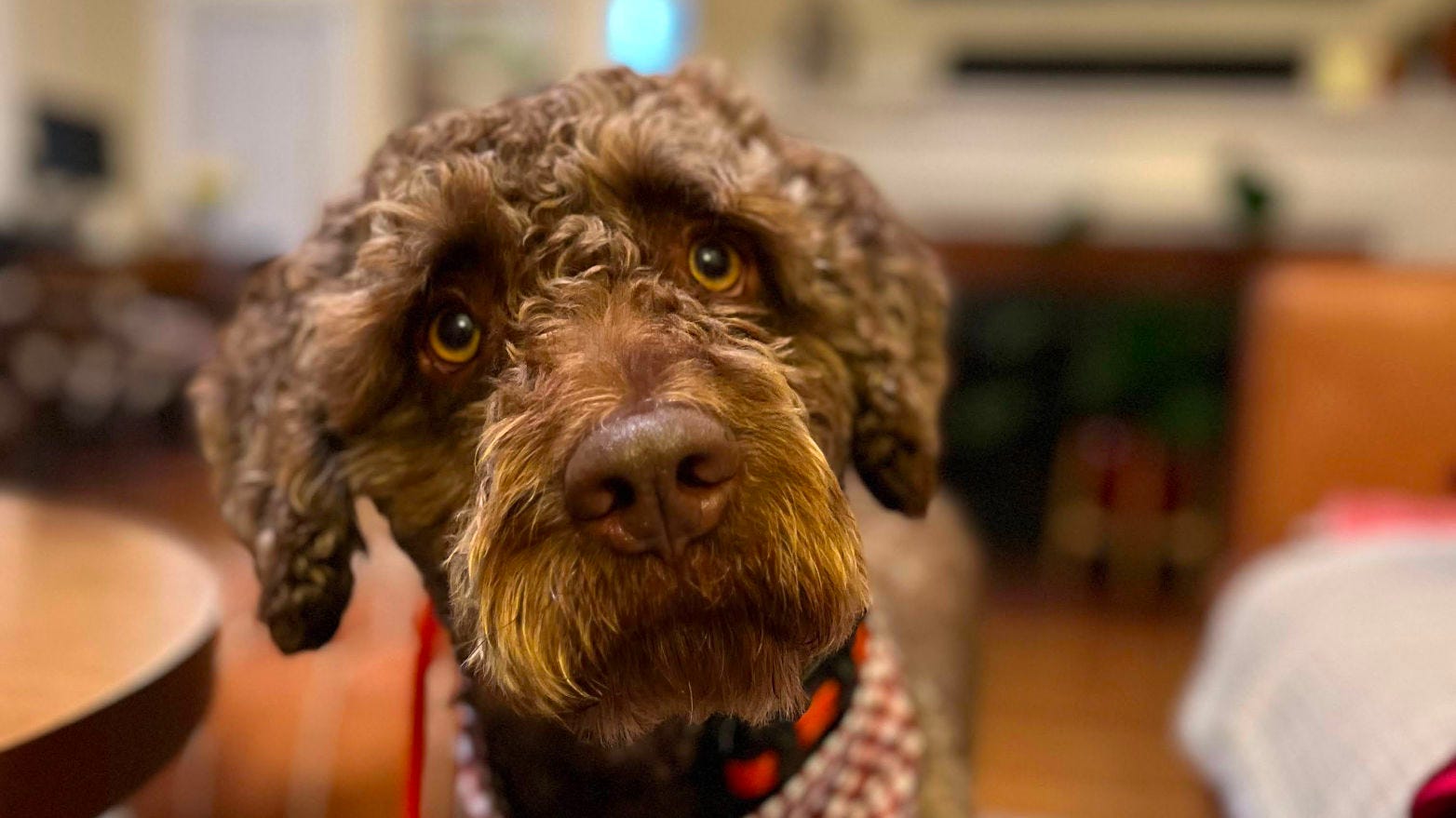
I knew what he wanted. What he’d been asking for in a hundred small ways, for months, was a ride in the truck, a trip, an exploration of places we’d never been. I’d been telling him no because I’d stopped believing that going anywhere would change anything.
I went anyway. We were gone two months and eight thousand miles. The simplest thing I learned, and the thing that took me the longest to understand, was that Paco’s paw on my shoulder was a small act of control I hadn’t yet taken — and the act itself was the medicine, not the outcome.
You don’t need eight thousand miles. You need one paw on your shoulder, real or metaphorical. And then you need to do the thing it asks of you.
Next week, on Ricky Sutton’s Future Media Substack, I’ll tell you about a particular small thing I did last week that relit my hope circuit. It was slightly rebellious, but it was a non-violent way of proving that I still have some measure of control. It was performed with Paco on a beach a certain billionaire has spent years trying to lock up. I’ll add the link in the comments here when it goes live.
In the meantime, I’d just ask you this: what’s the smallest controllable thing you could do today that you’ve been telling yourself doesn’t matter?
Do that.
PS: If you’ve done something out in the real world that switched on your hope circuit, tell us in the comments what it was. Your simple act of control can inspire others to do the same.
As someone who regularly geeks out over human psychology, I can’t believe I have never heard of the Hope Circuit before! I’ve always been a big proponent in the power of personal choice in building up our resilience, and this is fascinating (and honestly quite uplifting) research. Sure, it could be a little depressing to think that helplessness is our default, but how incredible it is that our brains are so willing to learn and shift to orient us towards hope. Small changes can lead to massive shifts in perspective!
One small way that I’ve learned to activate my Hope Circuit is by taking thoughtful ownership of my time. Saying yes to the things that truly matter, and confidently saying no to those that don’t align with my values. It’s a small habit, but as someone who spent a good chunk of my life saying yes to everything all the time, it’s been incredibly refreshing to watch how much my nervous system is able to relax when I realize I’ve got my own back. Thanks for a thoughtful read!
I promised to add a link to the article on Future Media once it went live. Here it is: https://rickysutton.substack.com/p/a-tech-billionaire-a-closed-beach
Now, dear readers, what's one small thing you've done in the last week that helped you realize that what you do in real life matters?